



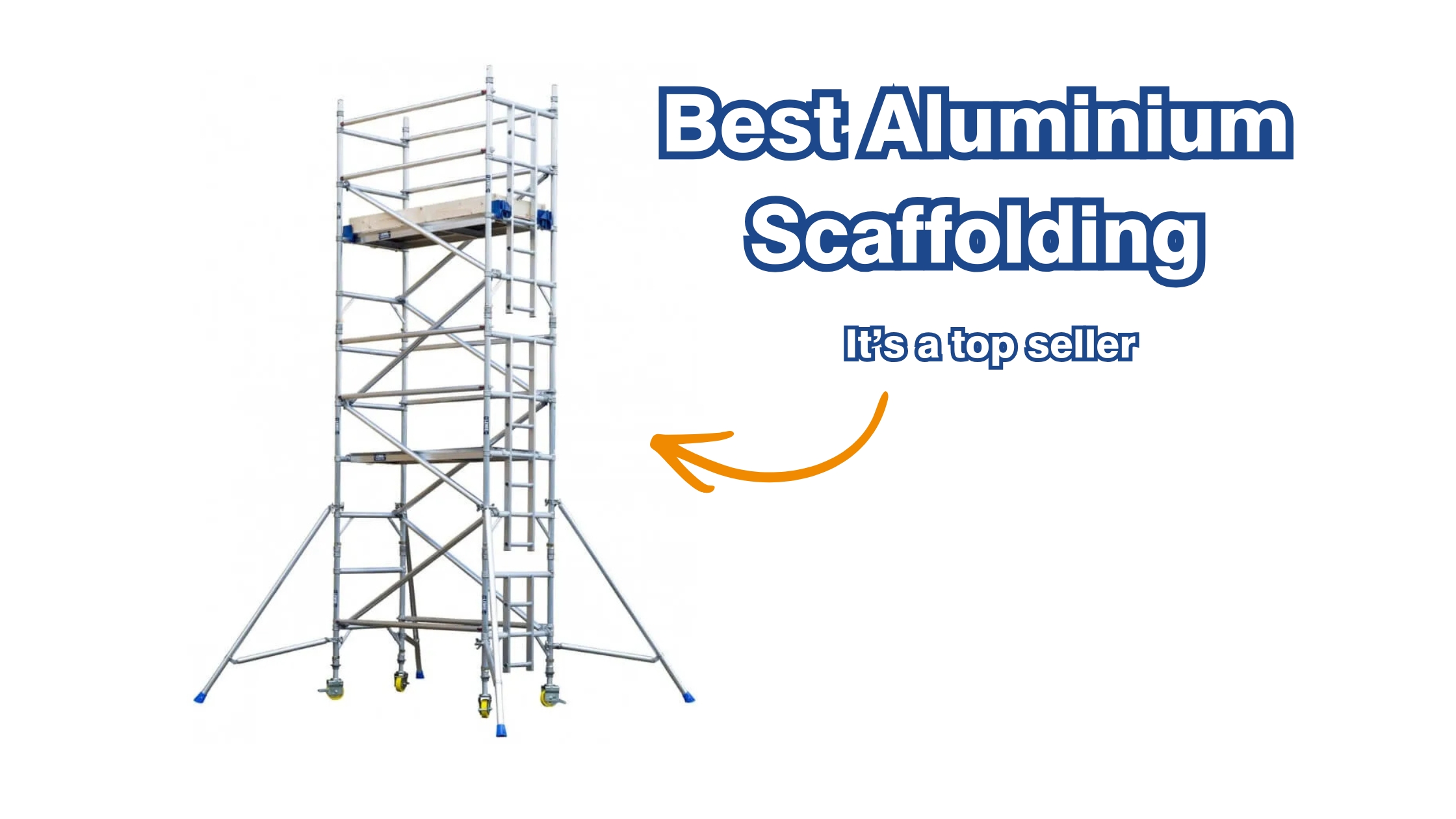
A good scaffold tower earns its place on site the same way a good tool does: by working hard, staying reliable, and not letting you down when it matters most. Whether you’re a painter covering a gable end, an electrician running cables through a warehouse ceiling, or a facilities team patching up brickwork on a school building, the tower beneath your feet has one job: keep you safe at height. Getting that choice right is everything.
Finding the best aluminium scaffold tower means weighing up portability against stability, platform size against storage space, and compliance against cost. It’s a decision that affects every job you take it to, every person who climbs it, and every hour you spend setting it up or breaking it down. The wrong tower costs you time, money, and potentially much worse. The right one becomes the most dependable piece of kit on your van. This guide breaks down what separates a quality tower from a mediocre one, from materials and design features to safety standards and maintenance, so you can make a decision you won’t regret.
Key Advantages of Choosing Aluminium Scaffold Towers
Aluminium has been the material of choice for mobile scaffold towers for decades, and for good reason. It strikes a balance between strength and weight that steel simply can’t match for mobile access work. But not all aluminium towers are created equal. The alloy grade, the extrusion quality, and the manufacturing tolerances all play a part in how a tower performs over years of hard use.
Lightweight Portability and Ease of Transport
A single-width aluminium tower that reaches six metres can weigh as little as 80 to 90 kilograms in total. Break that down into individual frames, braces, and platforms, and you’re handling components that one person can comfortably carry. Compare that to a steel equivalent, and you’re looking at roughly double the weight for the same working height.
This matters enormously in practice. If you’re a two-person team loading a van at 6 a.m. and unloading on site twenty minutes later, every kilogram counts. Lighter components mean faster erection times, less fatigue, and fewer trips between the van and the work area. LEWIS Access towers, manufactured in London, are designed with this in mind: the frames and braces are sized to fit through standard doorways and stack efficiently in a long-wheelbase van.
Portability also affects where you can use the tower. Lightweight aluminium means you can wheel a fully assembled tower across a flat warehouse floor, reposition it in a corridor, or break it down and carry it up a flight of stairs to reassemble on an upper level. Try doing that with steel scaffolding.
Corrosion Resistance for Outdoor Longevity
Aluminium naturally forms a thin oxide layer on its surface that protects it from corrosion. Unlike steel, which rusts the moment its protective coating is scratched, aluminium shrugs off rain, humidity, and the odd splash of mortar. This makes it ideal for outdoor maintenance work where towers might sit on damp ground or get rained on mid-job.
That said, aluminium isn’t completely invulnerable. Prolonged contact with certain chemicals, alkaline substances like wet cement, or dissimilar metals can cause pitting over time. Rinsing components down after exposure and storing them dry will keep your tower in good condition for fifteen years or more. Many LEWIS towers still in active service were manufactured over a decade ago, a testament to how well aluminium holds up with basic care.
Structural Rigidity and Load-Bearing Capacity
There’s a common misconception that lightweight means flimsy. It doesn’t. A well-engineered aluminium scaffold tower rated to EN 1004-1:2020 can support platform loads of 275 kg per platform level. That’s two people, their tools, and materials, all at height, with a generous safety margin built in.
The rigidity comes from the design: the triangulated bracing, the precision-welded joints, and the interlock between frames. A tower that flexes or sways under load is a tower that’s either poorly designed or incorrectly assembled. When you stand on a properly built aluminium tower, it should feel solid. No wobble, no give, no creaking. If it doesn’t feel right, something’s wrong.
Essential Features to Look for in a High-Quality Tower
Not every tower on the market deserves your money. Some are built to a price point rather than a safety standard. Knowing which features separate a professional-grade tower from a cheap one will save you grief down the line.
Integral Ladder Systems and Safe Access
How you get onto the platform matters just as much as the platform itself. The best towers have built-in ladder access: either rungs integrated into the end frames or a dedicated internal ladder system that keeps your climbing route within the tower’s footprint.
Climbing up the outside of a tower is one of the most common causes of tip-over incidents. An internal access system keeps your weight centred and your hands on the structure at all times. Look for:
- Rung spacing that conforms to EN 1004-1:2020 requirements (no more than 300 mm apart)
- Anti-slip rung surfaces, either knurled aluminium or rubber-coated
- Comfortable rung depth: at least 20 mm so your boots grip properly
- A clear climbing line that doesn’t require you to contort around braces
Some manufacturers treat the access system as an afterthought. It shouldn’t be. If climbing the tower feels awkward or unsafe, people will find shortcuts, and shortcuts at height get people hurt.
Dual-Action Locking Castors and Stabilisers
Castors let you wheel a tower into position. Locks keep it there. Both functions need to work flawlessly every single time.
Dual-action locking castors require two separate movements to release: typically a foot-operated brake and a swivel lock. This prevents accidental release. If someone bumps into the tower or leans against it, the castors stay locked. Single-action castors, the kind you’ll find on budget towers, can be knocked off their locks far too easily.
Outrigger stabilisers extend the tower’s effective base, reducing the risk of overturning. For any tower over a certain height-to-base ratio, stabilisers aren’t optional: they’re required by the Working at Height Regulations 2005. Adjustable stabilisers with screw jacks let you level the tower on uneven ground, which is something you’ll encounter on almost every outdoor job.
Platform Dimensions and Trapdoor Options
Your platform is your workspace. Too small, and you’re constantly shuffling tools around and reaching beyond safe limits. Too large, and you’ve added weight and bulk you don’t need.
Single-width platforms are typically 0.85 m wide by either 1.8 m or 2.5 m long. Double-width platforms run at 1.35 m to 1.45 m wide. For most trade work, a 2.5 m long platform gives you enough room to work comfortably without excessive reaching.
Trapdoor platforms are worth insisting on. They allow you to climb up through the platform and close the hatch behind you, maintaining a complete working surface and preventing falls through the access point. A tower without trapdoor platforms forces you to climb over the edge of the platform at each level, which is less safe and slower.
Selecting the Right Configuration for Your Project
Buying a tower isn’t a one-size-fits-all decision. The configuration you need depends on the work you’re doing, the space you’re doing it in, and how high you need to reach.
Single Width vs Double Width Towers
Single-width towers (around 0.85 m wide) are the go-to choice for work in confined areas: corridors, between racking in warehouses, along narrow building elevations. They fit through standard single doorways and take up minimal floor space. For a sole trader or a small team doing routine maintenance, a single-width tower covers most jobs.
Double-width towers (1.35 m to 1.45 m wide) give you a bigger platform, more stability, and a higher maximum working height. If you’re doing plastering, cladding, or any work that involves heavy materials on the platform, double width is the sensible choice. The wider base also means you can reach greater heights before stabilisers become necessary, though you should always follow the manufacturer’s height-to-base ratio guidance.
LEWIS Access manufactures both configurations, and the components are designed to be interchangeable where possible. That means a team can stock single-width and double-width frames and adapt their tower to the job at hand, rather than owning two completely separate systems.
Working Height vs Tower Height Explained
This trips people up constantly. Tower height (or platform height) is the height of the standing platform above ground level. Working height adds roughly 2 metres to that figure, representing the height a person of average stature can comfortably reach while standing on the platform.
So a tower with a platform height of 4.2 m gives you a working height of approximately 6.2 m. When you’re quoting for a job or specifying equipment, make sure you and your client are talking about the same measurement. Turning up with a tower that’s two metres short of where you need to be is an expensive mistake.
Most manufacturers list both figures in their specifications. If they only list one, ask which it is before you order.
Specialised Solutions for Stairwells and Tight Spaces
Stairwells are among the trickiest environments for working at height. The floor level changes, the space is confined, and standard tower configurations won’t sit level. Stairwell towers use adjustable leg lengths to compensate for the height difference between steps, allowing you to create a level platform over a staircase.
These aren’t bodged-together workarounds. A properly designed stairwell kit uses the same quality components as a standard tower but with additional frame options and adjustable sections. If your work regularly takes you into stairwells, schools, office blocks, or residential properties, a stairwell conversion kit is a worthwhile investment. It’s far safer than the improvised solutions some people still resort to, and it keeps you compliant with regulations.
Safety Standards and UK Regulations
Safety isn’t a feature you bolt on. It’s built into the design, the manufacturing process, and the way the tower is used on site. UK regulations are clear on what’s expected, and ignorance isn’t a defence.
Understanding EN 1004-1:2020 Compliance
EN 1004-1:2020 is the European standard for mobile access towers, and it’s the benchmark you should hold every tower against. It covers structural design, stability, platform dimensions, guardrail heights, and load capacity. A tower that meets this standard has been independently tested and verified.
Look for the EN 1004 classification label on the tower, which should state the load class (typically Class 3 for professional use, supporting 200 kg per platform) and the maximum height. Towers sold without this classification are a red flag. They may be cheaper, but they haven’t been through the same rigorous testing programme, and using non-compliant equipment on a commercial site puts you on the wrong side of the Health and Safety Executive.
LEWIS scaffold towers are manufactured to meet EN 1004-1:2020 and are also compatible with SGB Boss and Youngman Boss systems. That compatibility matters if you’re working on larger sites where different brands of tower components might need to work together.
The Importance of 3T and AGR Assembly Methods
The 3T method (Through the Trap) and AGR (Advance Guard Rail) are the two approved assembly methods for mobile scaffold towers in the UK. Both are designed to ensure that the person building the tower is always protected by guardrails before they step onto a new platform level.
With 3T, you climb through the trapdoor, stand on the platform, and then add guardrails around you. With AGR, temporary guard rails are pushed up and locked into place from the level below before anyone climbs to the next level. Both methods eliminate the need to stand on an unprotected platform at any point during assembly.
If you or your team haven’t been trained in these methods, get trained. PASMA (the Prefabricated Access Manufacturers’ Association) runs courses across the UK, and a PASMA card is increasingly expected on commercial sites. It’s a one-day course that could prevent a life-changing accident.
Maintenance and Storage Best Practices
A well-maintained tower lasts. A neglected one becomes a liability. The good news is that aluminium towers need very little upkeep compared to steel, but “very little” isn’t the same as “none.”
Pre-Use Inspection Checklists
Every time you set up a tower, someone competent should inspect it before anyone climbs it. This isn’t bureaucracy: it’s basic site safety. Here’s what to check:
- All locking mechanisms engage fully and hold firm
- No visible cracks, dents, or deformation in frames or braces
- Castors spin freely, brake firmly, and swivel locks engage
- Platforms sit flat with no warping or damage to trapdoor hinges
- Stabilisers are fitted where required and adjusted to firm ground contact
- Toe boards and guardrails are in place at every working level
Keep a written record of each inspection. It takes two minutes and gives you a paper trail if anything is ever questioned. Many contractors use a simple tick-sheet stored in the tower bag.
Cleaning and Storing Components for Durability
After use, knock off any loose dirt or mortar and give the components a wipe down, especially if they’ve been exposed to plaster, cement, or chemicals. A bucket of warm water and a stiff brush is all you need. Don’t use wire wool or abrasive cleaners on aluminium: they’ll damage the oxide layer that protects it.
Store components indoors if possible, or under cover at minimum. Stack frames vertically in a rack or horizontally on bearers to prevent bowing. Keep castors off damp floors. Lubricate any moving parts (castor axles, brace clips, platform hinges) with a light machine oil once or twice a year.
Proper storage also means proper organisation. Label your components or use colour-coded tags so you can grab what you need without sorting through a pile. LEWIS Access delivers towers with clear component lists, and their UK-wide fleet of HGVs means replacement parts arrive quickly if anything does wear out or get damaged.
Final Verdict: Investing in the Best Aluminium Scaffold Towers
The best aluminium scaffold tower is the one that fits your work, meets the standards, and keeps your team safe every single day. It’s not necessarily the cheapest option on the market, and it’s definitely not the heaviest or the most complicated. It’s the one that goes up quickly, stands firm, gives you room to work, and comes down at the end of the day without drama.
Quality matters here more than in almost any other piece of equipment you’ll buy. A tower is the thing standing between your team and a fall from height. That’s not where you cut corners.
If you’re looking for a tower that’s manufactured in London by people who understand the trade, backed by over 3,000 five-star reviews, and delivered on LEWIS Access’s own fleet, you’re looking in the right place. Talk to the team, tell them what you need, and they’ll spec the right tower for the job. That’s how it should work: straightforward, honest, and built to last.