



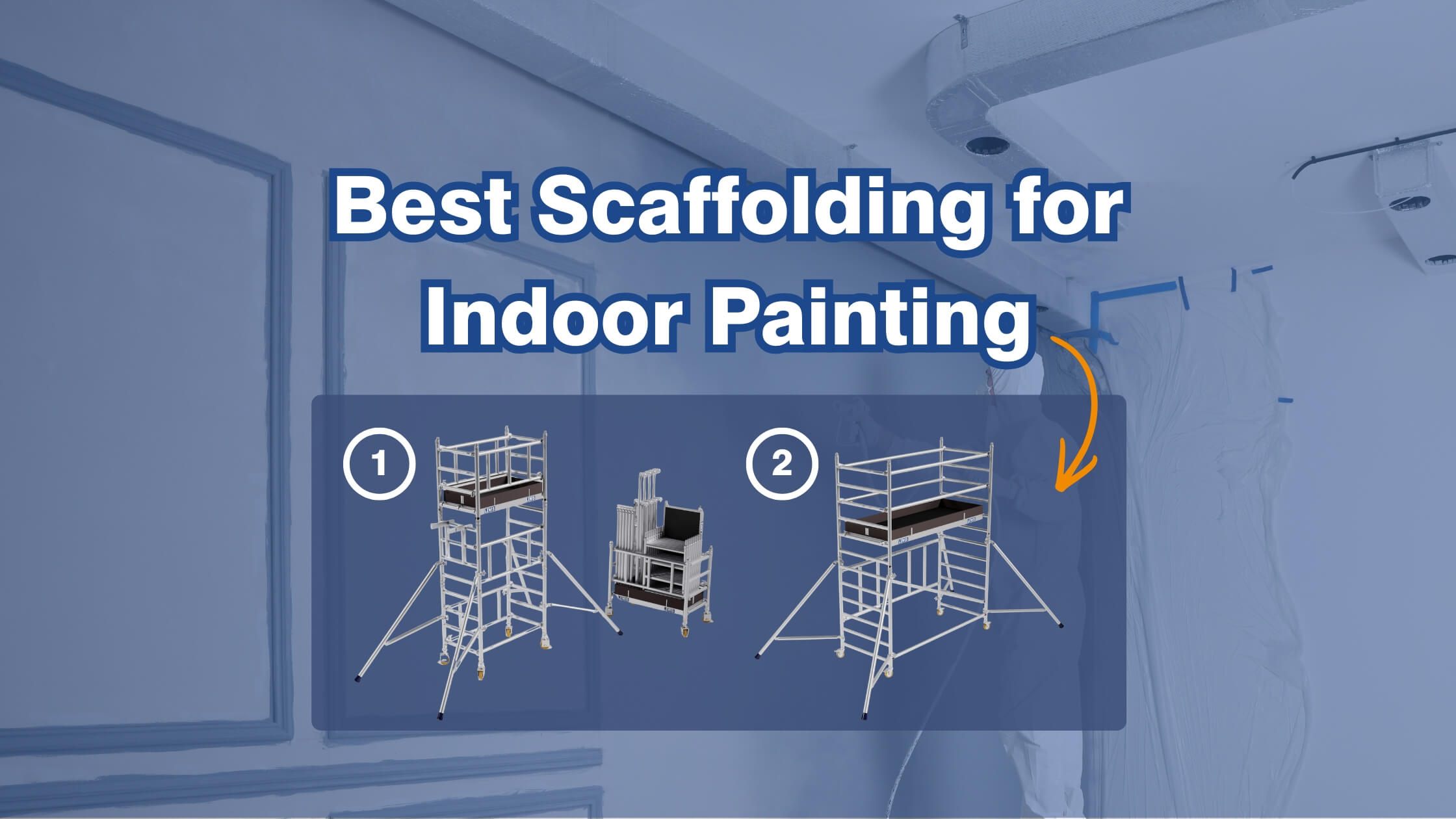
Standing on a wobbly stepladder with a roller in one hand and a tray balanced on the top cap is nobody’s idea of a good time.
Yet that’s how most people approach painting ceilings, stairwells, and high walls indoors.
There’s a better way, and it starts with choosing the best scaffolding for interior painting.
Whether you’re a decorator tackling a period property with four-metre ceilings or a maintenance team repainting a commercial lobby, the correct indoor access platform transforms the quality of your finish, the speed of your work, and – most critically – your safety.
Picking the best scaffolding for interior painting means balancing height, footprint, portability, and compliance with working at height regulations.
Get it right, and you’ll wonder how you ever managed without it.
Get it wrong, and you’ll be wrestling an oversized tower through a doorframe while the paint dries on your roller.
This guide covers every practical consideration, from tower types and key features to hire-versus-buy decisions and long-term maintenance.
Selecting the Right Scaffolding for Interior Spaces
Choosing indoor scaffolding is a different exercise from selecting an outdoor tower. Outside, you’re dealing with wind loads, uneven ground, and weather. Inside, the constraints are narrower doorways, finished flooring, ceiling heights that vary room to room, and the simple fact that you’re working in a confined space alongside furniture, fittings, and sometimes other trades. The scaffolding that works brilliantly on a gable end may be entirely wrong for a hallway.
The first step is honest assessment. What’s the maximum height you need to reach? How much floor space can you sacrifice? Will you need to move the platform between rooms, and if so, how narrow are the corridors and doorways? These questions shape every decision that follows.
Benefits of Scaffolding vs. Ladders for Painting
A ladder gives you a single point of contact with the wall. You reach, you stretch, you climb down, you move the ladder, you climb back up. It’s slow, it’s tiring, and it’s the reason so many decorators end up with inconsistent finishes – you’re constantly changing your angle and reach.
A scaffold platform, even a low-level one, gives you a stable working area where you can stand upright, move laterally, and keep your materials within arm’s reach. That means longer, more consistent brush strokes and roller passes. It means fewer drips from rushing. And it means dramatically less fatigue over a full day’s work.
From a safety perspective, the difference is stark. The Health and Safety Executive’s data consistently shows that falls from ladders remain one of the most common causes of workplace injury in the UK. A properly assembled scaffold tower with guardrails, toe boards, and a full platform eliminates most of the risks that make ladder work dangerous: overreaching, the ladder slipping at the base, and the instability that comes from working one-handed while holding a tool.
Assessing Room Height and Floor Space
Measure your ceiling heights before you look at a single product. Standard UK residential ceilings sit around 2.4 metres, but Victorian and Edwardian properties often reach 3 to 3.5 metres, and commercial spaces can be significantly higher. You need a platform height that puts the ceiling comfortably within roller reach – typically your platform should be about 1.2 to 1.5 metres below the ceiling for painting work.
Floor space matters just as much. A full-size mobile tower with a 1.8m x 1.2m base gives you a generous platform, but it won’t fit through a standard 762mm door opening. Measure your narrowest access point – the doorframe, the corridor, the lift if you’re working in a block of flats – and work backwards from there. LEWIS Access manufactures towers with narrow base options specifically for this reason, with some configurations fitting through standard doorways without dismantling.
Don’t forget the floor itself. Carpet, hardwood, tiles, and vinyl all respond differently to point loading. A tower concentrating 200kg through four small castors can leave marks on a soft floor unless you’ve planned for it.
Top Scaffolding Types for Internal Decorating
Not all indoor scaffolding is created equal. The right choice depends on the specific job, and most professional decorators end up using more than one type across different projects. Here’s what’s available and where each type excels.
Folding Indoor Scaffolding Units
Folding scaffold units are the workhorses of residential decorating. They typically offer platform heights between 0.7 and 1.0 metres, fold flat for storage and transport, and weigh under 25kg. Think of them as the step between a stepladder and a proper tower.
They’re brilliant for standard-height rooms where you need a stable platform for ceiling work. Most fold to around 150mm deep, so they’ll slide behind a van seat or stand in a cupboard. Setup takes seconds rather than minutes.
The limitation is height. If you’re working in a room with ceilings above about 2.7 metres, a folding unit won’t get you close enough. They also lack guardrails, which means they’re only suitable for work where the platform is below the two-metre threshold specified in the Work at Height Regulations 2005.
Mobile Tower Scaffolds with Lockable Castors
For anything above standard ceiling height, a mobile aluminium scaffold tower is the professional’s choice. These towers use modular frames – typically built from lightweight aluminium sections – that stack to reach working heights of four metres or more indoors.
The castors are the key feature for interior work. Lockable castors let you wheel the tower into position, lock it solid for work, then unlock and reposition without dismantling. This is where you save hours on a large project. A decorator painting a school hall, for instance, can roll the tower along the wall in stages rather than stripping it down and rebuilding it every few metres.
LEWIS scaffold towers are designed with this exact workflow in mind. Their aluminium frames are compatible with SGB Boss components, which means tradespeople who already own SGB Boss fittings can integrate LEWIS sections without buying an entirely new system. The towers ship from London via LEWIS Access’s own fleet of HGVs, so delivery timelines are reliable and you’re not waiting on a third-party courier.
Look for towers with an adjustable base that allows you to level the platform on uneven floors. Many older buildings have floors that slope noticeably, and a tower that can’t compensate will leave you working on a tilted platform – uncomfortable and potentially unsafe.
Stairwell Scaffolding Solutions
Stairwells are the decorating jobs that everyone dreads. The geometry is awkward: you need to work at height over a void, with the floor level changing beneath you. Ladders are dangerous here, and a standard tower can’t straddle the steps.
Stairwell scaffolding uses adjustable leg lengths to create a level platform over the stairs. The best systems allow each leg to be set independently, so you can place one leg on the landing and another three or four steps down while keeping the platform perfectly horizontal.
Some manufacturers offer dedicated stairwell kits. Others, including LEWIS Access, provide adjustable leg extensions that work with their standard tower frames. The advantage of the latter approach is versatility: you buy one tower system and adapt it for stairs, flat floors, or split-level spaces as needed.
If you’re working in a stairwell, pay particular attention to how the tower is braced. The offset loading from uneven leg heights creates different stress patterns compared to a tower on flat ground, and proper diagonal bracing is essential for stability.
Podium Steps and Low-Level Platforms
Not every interior painting job needs a full tower. Podium steps occupy the middle ground between a stepladder and a scaffold tower, offering platform heights of around 0.5 to 1.0 metres with the stability of a wide base and, on better models, a guardrail.
They’re ideal for touch-up work, cutting in around coving, and painting walls in standard-height rooms. A good podium step has a large enough platform to stand on comfortably with a paint kettle beside you, and it’s light enough for one person to carry between rooms.
For maintenance teams doing regular repainting across a building, podium steps are often the most practical daily-use platform. They set up instantly, they’re stable on most floor surfaces, and they store compactly. Save the full tower for the high-ceiling spaces and stairwells.
Key Features to Look for in Interior Towers
Once you’ve settled on a tower type, the details matter. A few specific features separate a tower that’s a pleasure to use indoors from one that damages floors, jams in doorways, and leaves you frustrated.
Width and Manoeuvrability through Doorways
The standard UK internal door opening is 762mm wide. Many scaffold towers, especially those designed primarily for outdoor use, have base widths of 850mm or more. That’s a problem.
Look for towers with a narrow scaffold towers with around 700mm width or less. Some systems offer a choice of frame widths so you can configure the tower for the specific job. If you’re working in a building with wider commercial doorways, you can use the full-width frames for maximum platform space. In a terraced house with narrow halls, switch to the slim configuration.
Castor diameter affects manoeuvrability too. Larger castors roll more smoothly over carpet and minor floor imperfections, but they add to the overall height. For very low ceiling spaces, smaller castors might be the better compromise.
Weight Capacity and Tool Storage
Check the safe working load of any tower you’re considering. This isn’t just your body weight – it includes paint, rollers, trays, brushes, and any other materials on the platform with you. A decorator with a full set of equipment can easily account for 30 to 40kg of tools and materials on top of their own weight.
Most quality aluminium towers from manufacturers like LEWIS Access and Youngman Boss are rated to 275kg per platform distributed evenly. That’s ample for a single decorator with tools. If two people will be working on the platform simultaneously, you need a higher rating and a wider platform.
Some towers include integrated tool trays or hooks for hanging paint kettles. These small features make a surprising difference to workflow. Having your materials at hand rather than on the platform beside your feet means less tripping risk and more usable standing space.
Non-Marking Components for Finished Floors
This is the feature that separates indoor-specific scaffolding from general-purpose towers. Standard steel castors will scratch hardwood, dent vinyl, and leave black marks on tiles. For interior work, you need non-marking rubber or polyurethane castors and, ideally, rubber foot caps on any outrigger legs.
Some decorators use plywood sheets or carpet offcuts under the castors as floor protection. That works, but it’s an extra step, and the sheets can shift if the tower is repositioned frequently. Purpose-built non-marking castors are a better long-term solution.
Check the base plates too. If the tower uses adjustable screw jacks for levelling, the foot pads should be broad enough to spread the load and soft enough not to mark the floor. A 200kg point load through a 25mm steel disc will damage almost any domestic flooring.
Safety Regulations and Best Practices
No discussion of scaffolding is complete without addressing safety, and frankly, this is the part that matters most. A beautiful paint finish means nothing if someone gets hurt achieving it.
Understanding Work at Height Regulations
The Work at Height Regulations 2005 apply to all work at height where there is a risk of a fall liable to cause personal injury. That includes standing on a scaffold tower indoors. The regulations require employers to ensure that work at height is properly planned, supervised, and carried out by competent persons. Equipment must be appropriate for the task, properly maintained, and inspected.
For scaffold towers specifically, the regulations require that towers are assembled, altered, and dismantled by people who have received appropriate training. The PASMA (Prefabricated Access Suppliers’ and Manufacturers’ Association) training programme is the industry standard for tower scaffold users, and most commercial clients now require PASMA certification before allowing tower work on their sites. LEWIS Scaffold Towers has partnered with She-Knows by supporting the creation of online videos with their own towers for scaffold tower certification.
Even if you’re a sole trader working in residential properties, the regulations still apply to you. Competence isn’t just about having a card – it’s about understanding how to inspect components, recognise damage, and assemble the tower according to the manufacturer’s instructions.
Stabiliser and Outrigger Requirements
Stabilisers and outriggers increase the effective base of the tower to prevent overturning. Outdoors, they’re almost always required. Indoors, the requirements depend on the tower height and configuration.
As a general rule, if the tower height exceeds three times the minimum base dimension, you need stabilisers or to tie the tower to the structure. A tower with a 700mm base width, for example, should not exceed 2.1 metres in platform height without stabilisers. That’s a real constraint for narrow indoor towers in high-ceilinged rooms.
Outriggers extend the footprint but also extend the floor space the tower occupies. In a tight room, this can be problematic. Some manufacturers offer wall ties as an alternative to outriggers for indoor use, securing the tower to the building structure rather than widening its base. Check what options your chosen tower system supports and plan accordingly.
Always follow the manufacturer’s assembly guide. The stability calculations are specific to each tower model, and a configuration that’s safe for one brand may not be safe for another, even if the dimensions look similar.
Hiring vs. Buying Interior Scaffolding
The hire-or-buy question depends on how often you’ll use the equipment. For a one-off project, hiring makes obvious sense. Weekly hire rates for a basic indoor tower start at around £50 to £80, and you avoid the storage problem entirely.
For professional decorators and maintenance teams, the maths shifts quickly. If you’re hiring a tower for more than six to eight weeks per year, purchasing becomes more economical within the first year or two. A quality aluminium tower from a manufacturer like LEWIS Access will last decades with proper care, so the long-term cost per use drops to almost nothing.
Buying also gives you the flexibility to leave the tower assembled between jobs on the same site, to customise your configuration with accessories, and to avoid the logistics of collection and return. LEWIS Access delivers across the UK using their own fleet, and their towers carry over 3,000 five-star reviews from tradespeople who use them daily.
If you do hire, inspect the equipment carefully on delivery. Check for bent frames, cracked welds, missing clips, and worn castors. You’re responsible for the safety of the tower once it’s on your site, regardless of who owns it.
One middle-ground option: buy a basic low-level platform or podium step for everyday use, and hire a full tower for the occasional high-ceiling job. That way you’ve always got a safe platform available without committing to the cost and storage of a full tower system.
Maintenance and Storage for Long-Term Use
Aluminium scaffold towers are low-maintenance, but they’re not no-maintenance. A few simple habits will keep your equipment safe and functional for years.
After each job, clean the frames. Paint drips, plaster dust, and adhesive residue build up on locking mechanisms and castor bearings. A stiff brush and some warm soapy water is usually enough. Don’t use solvents on plastic components or rubber castors – they’ll degrade the material.
Inspect every component before storage. Look for:
- Bent or dented frame sections
- Cracks around weld points
- Worn or stiff locking clips
- Castors that don’t spin freely or lock securely
- Missing or damaged bracing pins
Any damaged component should be replaced before the tower is used again. Using a tower with a compromised frame isn’t just risky – it’s a breach of the Work at Height Regulations and could invalidate your insurance.
Store the tower in a dry location. Aluminium doesn’t rust like steel, but the steel pins, clips, and castor mechanisms can corrode if left in damp conditions. If you’re storing frames in an unheated garage or shipping container, consider a light coat of silicone spray on the moving parts.
Keep the frames off the ground on a rack or shelf. Stacking them flat on a concrete floor invites damage from foot traffic, vehicles, and other stored equipment. A simple wall-mounted rack keeps everything organised, visible, and protected.
Retain the manufacturer’s assembly instructions with the tower. If you’re using a LEWIS Access or compatible SGB Boss system, the instruction manual specifies the exact configurations that have been tested and approved. Assembling the tower in any other configuration voids the safety rating. Keep that manual where you can find it.
So, what’s the best scaffolding for interior painting?
The right indoor scaffolding setup pays for itself in time saved, quality improved, and injuries avoided. Whether you’re a sole-trader decorator or part of a facilities maintenance team, matching the platform to the job is one of the most practical decisions you’ll make. Start with your ceiling heights, work through the access constraints, choose quality aluminium from a manufacturer you trust, and follow the regulations. The painting will take care of itself.