



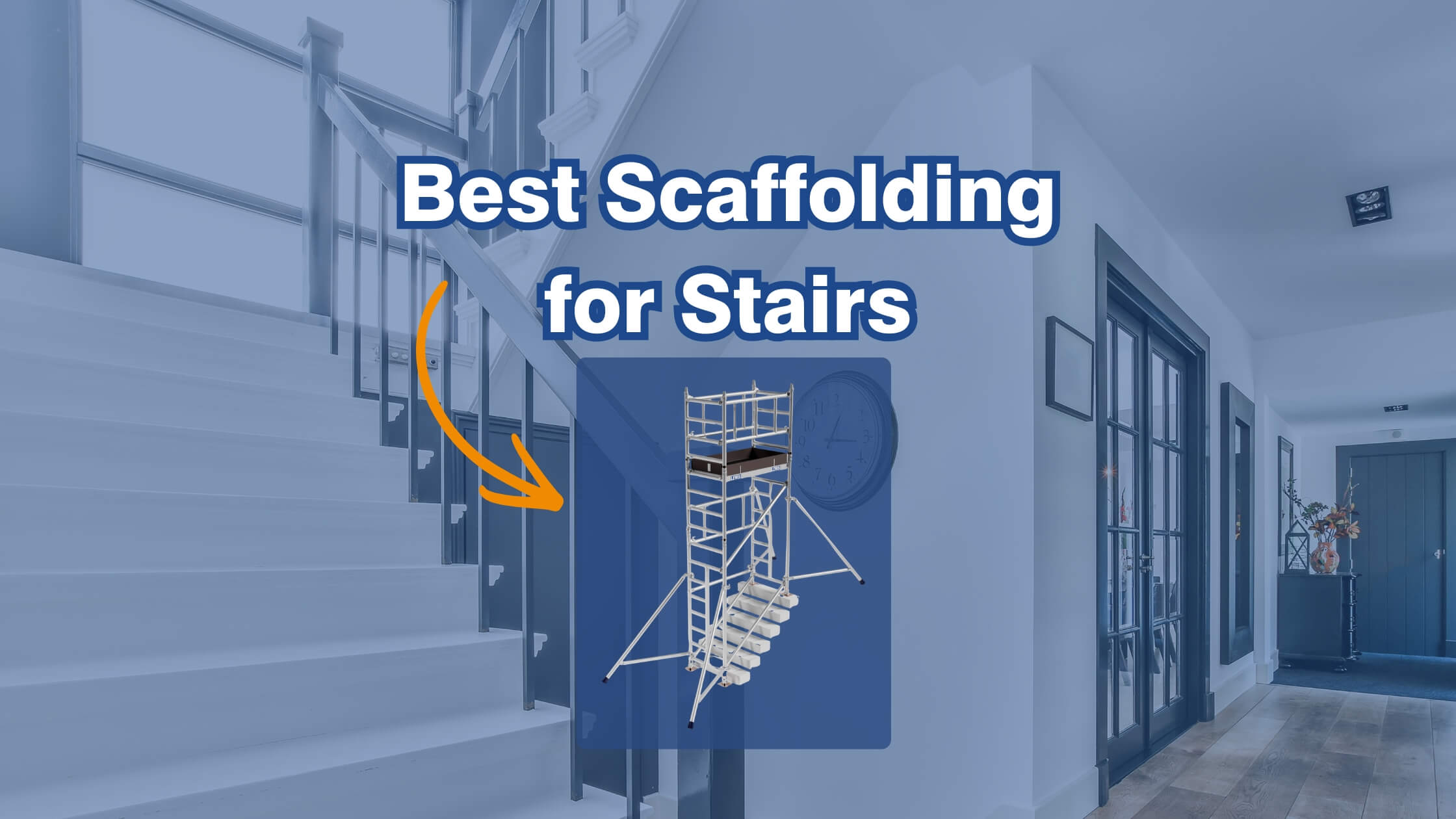
Working at height over a staircase is one of the most awkward jobs in construction and maintenance. The geometry is against you: uneven levels, angled surfaces, tight landings, and walls closing in on both sides.
A standard tower or a couple of stepladders with a plank between them won’t cut it, and frankly, that kind of improvisation is how people get hurt.
Finding the best scaffolding for stairs means matching the right equipment to the specific challenge a stairwell presents, whether you’re a plasterer finishing a ceiling above a domestic flight or a maintenance team repainting a commercial atrium staircase.
The stakes are real.
Falls from height remain the leading cause of workplace fatalities in the UK construction sector, and a disproportionate number of those incidents involve makeshift access over stairs. Getting this decision right protects your crew, keeps you compliant, and actually speeds up the work.
This guide breaks down the types, features, materials, and safety considerations that matter most when you’re choosing stair scaffolding in 2026.
Essential Considerations for Staircase Scaffolding
Before you start comparing products or brands, you need a clear picture of the job itself. Staircase scaffolding isn’t one-size-fits-all. The dimensions of the stairwell, the loads you’ll be placing on the platform, and whether the work is indoors or outdoors all shape which solution makes sense. Skipping this assessment stage is the fastest route to buying or hiring kit that doesn’t fit, doesn’t perform, or doesn’t comply with regulations.
Assessing Staircase Dimensions and Layout
Start by measuring everything. You need the width of the staircase, the floor-to-ceiling height at the lowest and highest points, the going (horizontal depth) and rise of each step, and the dimensions of any landings. Don’t forget to check the headroom above the top landing: many domestic staircases have ceilings that slope with the pitch of the roof, and that changes your platform height options.
Straight flights are the simplest scenario. Half-landings, quarter-turns, and spiral staircases each introduce complications. A half-landing, for instance, gives you a flat area to position one leg of the scaffold, but the other legs may need to sit at different step levels. Spiral staircases are the trickiest: the curvature means standard rectangular platforms often can’t span the full width, and you may need a combination of adjustable components.
Sketch the layout before you shop. Note where radiators, handrails, and door openings restrict access. A scaffold that technically fits but blocks the only fire escape route on a commercial site is a non-starter.
Weight Capacities and Load Requirements
Every scaffold has a Safe Working Load (SWL), and you need to respect it. The SWL includes the combined weight of workers, tools, materials, and the platform itself. For a single tradesperson doing light work like painting, a platform rated at 150 kg may be sufficient. For two operatives with power tools and plasterboard, you’re looking at least 275 kg.
Check the manufacturer’s data sheet, not just the marketing headline. Some products quote the SWL per platform level, others quote the total for the entire tower. There’s a big difference. If you’re stacking materials on the platform while working, factor that in honestly. Overloading a scaffold on stairs is especially dangerous because the uneven leg positions already create asymmetric forces.
Indoor versus Outdoor Stairway Applications
Indoor stairwells demand compact equipment. You’re working with finished floors, painted walls, and limited ventilation. Non-marking castors or rubber feet are essential to avoid damaging surfaces. Weight matters too: carrying heavy steel components up a narrow domestic staircase is miserable and slow.
Outdoor stairs, such as fire escapes, entrance steps, or external access routes, are exposed to weather. Wind loading becomes a factor, particularly at height. Galvanised or powder-coated finishes resist corrosion. You’ll also need to consider the surface beneath the scaffold: wet stone steps, uneven concrete, and metal grating all affect stability differently. Outriggers and base plates become more important outdoors, and you may need to tie the scaffold to the building structure if the height exceeds the manufacturer’s freestanding limit.
Top Scaffolding Types for Stairs
Not all scaffolding is designed for stairs, and not all stair scaffolding suits every staircase. Here’s a practical breakdown of the three main types you’ll encounter.
Adjustable Stairwell Towers
These are purpose-built for the job. A stairwell tower has legs that extend independently, so you can set each one at a different height to match the steps beneath it. The platform stays level while the base conforms to the staircase geometry. Good stairwell towers from manufacturers like LEWIS Access are engineered with this exact application in mind: their aluminium towers are built and designed so that each leg locks securely at the required extension.
Stairwell towers typically offer platform heights from around 2 metres up to 6 metres or more, depending on the model and configuration. They’re the go-to choice for most professional staircase work because they provide a full-width, level working area with proper guardrails.
One thing to watch: make sure the tower you choose actually fits the staircase width. Some towers have a minimum footprint that’s wider than a standard domestic staircase. Check the spec before you commit.
Folding Scaffolding Units for Tight Spaces
Folding scaffold units collapse for transport and storage, then open out into a working platform. They’re lighter and more portable than full towers, which makes them popular for domestic maintenance work and quick jobs. Many models have built-in stair-adjustment features, though they tend to offer less height and lower SWLs than dedicated stairwell towers.
The trade-off is stability. A folding unit is inherently less rigid than a bolted or clipped tower. For short-duration work at modest heights, say painting a stairwell ceiling in a two-storey house, they’re perfectly adequate. For anything more demanding, a proper tower is the safer choice.
Look for folding units with locking hinges that click positively into place. If the locking mechanism feels vague or requires you to trust friction alone, walk away. A scaffold that folds is only useful if it stays unfolded while you’re standing on it.
Modular Tube and Fitting Systems
Traditional tube and fitting scaffolding can be configured for virtually any staircase, no matter how awkward the geometry. A skilled scaffolder can build a bespoke structure that wraps around corners, accommodates different levels, and provides platforms exactly where they’re needed.
The downside is time and cost. Erecting tube and fitting scaffolding requires a competent scaffolder, and the labour hours add up quickly. For large commercial projects, multi-storey stairwells, or unusual architectural features, this approach often makes sense. For routine maintenance or domestic work, it’s overkill.
If you go this route, ensure the scaffolder holds a valid CISRS card and that the design is checked by a competent person before use. Tube and fitting systems are only as safe as the person who builds them.
Key Features of the Best Stair Scaffolds
Certain features separate a good stair scaffold from a dangerous compromise. These are the things to look for when comparing products.
Independently Adjustable Legs
This is the single most important feature for staircase work. Each leg must adjust independently and lock at the chosen height. While this is mostly for levelling, it can be used to adjust the height slightly for uneven steps. Generally, when it comes to scaffold towers that meet the standard, there’s a dedicated span frame that is longer to account for the lower steps.
The adjustment mechanism should be simple, positive, and visible: you need to be able to confirm at a glance that every leg is locked. LEWIS Access, for example, uses a threaded aluminium tube with a spiral bolt that neatly joins with the bottom of the span frame.
Avoid any system that relies on friction pins alone without a secondary locking device. A pin can vibrate loose under load.
Non-Slip Platforms and Guardrails
The platform surface should be slip-resistant even when wet or dusty. Aluminium platforms with a textured or perforated surface perform well. Plywood decks work but can become slippery when coated in plaster dust or paint, but do meet the standards for tower scaffolds.
Guardrails are non-negotiable on any platform above 2 metres, and honestly, they’re a good idea at any height on stairs. A fall from 1.5 metres onto a staircase edge can cause serious injury. Look for scaffolds with integral guardrail systems that don’t require separate components: the fewer loose parts, the less likely someone is to skip installing them.
Toe boards prevent tools and materials from sliding off the platform edge onto anyone below. On a staircase, where someone might be walking underneath, toe boards are especially important.
Integrated Walk-Through Frames
Getting onto and off the platform safely is half the battle.
Walk-through frames allow you to step onto the platform without climbing over a guardrail. This matters because climbing over guardrails is one of the most common causes of slips or loss of balance.
Best Scaffolding Materials for Durability
The material your scaffold is made from affects its weight, durability, cost, and suitability for specific environments.
Lightweight Aluminium Solutions
Aluminium is the dominant material for portable scaffold towers, and for good reason. It’s light enough for one or two people to carry and assemble, it doesn’t rust, and it’s strong relative to its weight. A typical aluminium stairwell tower weighs between 40 and 80 kg, depending on the configuration, compared to well over 100 kg for an equivalent steel structure.
LEWIS Access manufactures its scaffold towers from aluminium in its London-based facility, and its products are compatible with SGB Boss and Youngman Boss components. That compatibility is genuinely useful if you already own towers from those brands: you can mix and match frames and platforms to build the configuration you need for a particular staircase without buying a completely new system.
For most indoor and outdoor staircase work, aluminium is the right choice. It’s easy to transport, quick to erect, and durable enough for years of professional use.
Heavy-Duty Galvanised Steel
Steel scaffolding is heavier and stronger. It’s the standard for large-scale construction sites where the scaffold will remain in place for weeks or months and needs to support heavy loads. For staircase work specifically, steel tube and fitting systems are common on commercial projects where the stairwell spans multiple floors.
The weight penalty is significant. Moving steel components through a building and up staircases requires more labour and more time. Galvanised coatings protect against corrosion, but they add cost. If you’re doing a one-off domestic job, steel is almost certainly more scaffold than you need.
Fibreglass Options for Electrical Work
Fibreglass (GRP) scaffold towers are non-conductive, which makes them essential for work near live electrical installations. If the staircase you’re working on runs alongside an electrical distribution board, or if you’re installing or maintaining electrical systems in the stairwell, a fibreglass tower eliminates the risk of the scaffold becoming a conduction path.
GRP towers are heavier than aluminium and more expensive. They’re also more brittle: a sharp impact can crack a fibreglass component where aluminium would dent. Treat them carefully, inspect them before each use, and store them out of direct sunlight to prevent UV degradation.
Safety Standards and Best Practices
No scaffold is safe if it’s erected incorrectly, used beyond its limits, or left uninspected. Here’s what compliance looks like in practice.
Complying with Work at Height Regulations
The Work at Height Regulations 2005 remain the primary legal framework in the UK. They require that all work at height is properly planned, supervised, and carried out by competent people using appropriate equipment. “Appropriate” is the key word: a ladder propped against a stairwell wall doesn’t meet the standard when a scaffold tower would be reasonably practicable.
Risk assessments must be specific to the task and location. A generic “working at height” risk assessment won’t cover the particular hazards of a staircase: uneven surfaces, restricted access, and the risk of falls down the stairs themselves. Document the staircase dimensions, the scaffold configuration, the SWL, and the emergency procedures.
If you’re working on a construction site, the scaffold also needs to comply with the Construction (Design and Management) Regulations 2015. The principal contractor has a duty to ensure all access equipment is suitable and properly maintained.
Pre-Use Inspection Checklists
Inspect the scaffold before every shift. This isn’t optional: it’s a legal requirement under the Work at Height Regulations. The inspection should be carried out by a competent person, and the results recorded.
A practical checklist for staircase scaffolds includes:
- All legs locked at the correct extension with no visible damage to locking mechanisms
- Platform boards fully seated and secured with no gaps greater than 25 mm
- Guardrails and toe boards in place on all open sides
- Castors locked (if fitted) and wheels in good condition
- No visible cracks, bends, or corrosion on any structural component
- Base plates or feet sitting firmly on the stair surface with no rocking
- The scaffold is plumb and level (use a spirit level on the platform)
If anything fails the check, don’t use the scaffold until it’s corrected. No exceptions.
Stabilisation and Outrigger Placement
Staircase scaffolds are inherently less stable than towers on flat ground because the base isn’t symmetrical. Outriggers extend the effective footprint and resist tipping. On stairs, outrigger placement is tricky: you may need to position them on different steps or on the landing.
Follow the manufacturer’s instructions for outrigger configuration. If the instructions don’t cover your specific staircase layout, contact the manufacturer for guidance.
LEWIS Access, for instance, provides technical support for their tower configurations and can advise on stabilisation for unusual setups. Don’t improvise: an outrigger placed incorrectly can actually make the scaffold less stable by creating a pivot point. Generally, you receive confined space stabilisers that stop the tower from tipping side to side, and there are also standard/telescopic stabilisers to reach the landing or hall below.
Tie the scaffold to the building structure if the platform height exceeds the freestanding limit specified by the manufacturer. Use proper scaffold ties, not rope or cable ties.
Choosing Between Hire and Purchase
This decision comes down to how often you work on staircases. If stairwell access is a regular part of your trade, say you’re a decorator, plasterer, or building maintenance operative, buying a quality stairwell tower pays for itself within a few hires. A well-maintained aluminium tower from a manufacturer like LEWIS Access will last decades, and you’ll always have the right kit on the van when you need it.
If staircase work is a once-a-year occurrence, hiring makes more sense. Hire companies stock a range of stairwell configurations, and you can get exactly the right size for each job without storing equipment you rarely use. Just make sure the hire company provides the full assembly instructions and that you’re trained to erect the specific model they supply.
There’s a middle ground too. Some trades buy a versatile base tower and hire additional stairwell components when needed. This works well if your standard tower is compatible with stairwell conversion kits. Check compatibility before assuming components from different manufacturers will fit together safely.
The cost difference is straightforward. A quality aluminium stairwell tower costs between £800 and £3,000, depending on the platform height and specification. Weekly hire rates for equivalent equipment run from £80 to £200. Do the maths for your own workload.
In the end, what’s the best scaffolding for stairs?
Whatever you choose, don’t let cost drive you toward unsafe alternatives. A proper stair scaffold is an investment in going home at the end of every shift. The best scaffolding for stairs is the equipment that fits the space, carries the load, meets the regulations, and gets used correctly every single time. If you’re unsure which configuration suits your needs, talk to the manufacturer.
LEWIS Access offers guidance based on decades of building towers for exactly these situations, and with UK-wide delivery on their own fleet, getting the right kit to your site is straightforward. Get it right once, and every stairwell job after that becomes simpler, faster, and safer.