



Working on uneven ground is one of the most common challenges tradespeople face on site.
A gentle slope in a garden, a stepped terrace, or a hillside extension can turn a straightforward scaffold setup into a genuine headache.
The wrong approach doesn’t just waste time: it puts lives at risk.
Every year, falls from height remain one of the leading causes of serious injury in the UK construction sector, and a significant proportion of those incidents trace back to poorly erected temporary structures on difficult terrain.
Choosing the best scaffolding for uneven ground isn’t a luxury; it’s a fundamental safety decision.
Whether you’re a sole trader tackling a chimney repair on a sloped driveway or a maintenance team working across varied sites, understanding which systems perform best on tricky terrain will save you time, money, and potentially a trip to A&E.
This guide breaks down the options, the essential components, and the legal requirements you need to know.
Challenges of Erecting Scaffolding on Slopes and Uneven Terrain
Uneven ground introduces a set of problems you simply don’t encounter on flat concrete. The forces acting on a scaffold tower or frame shift dramatically when the base isn’t level, and what seems like a minor gradient can create serious instability at working height. Understanding these risks is the first step toward managing them properly.
Common Hazards and Stability Risks
The most obvious danger is toppling. A scaffold tower that’s even slightly off-plumb will experience uneven loading, and the higher you build, the worse it gets. A 2-degree lean at ground level can translate into a significant horizontal offset at platform height, shifting the centre of gravity outside the base footprint.
Then there’s the risk of sliding. On grass, mud, or loose gravel, base plates can migrate under load, especially in wet conditions. This gradual movement might not be visible until the structure has already become dangerously compromised. Tradespeople sometimes compensate by wedging bricks or offcuts of timber under the legs, but this is an incredibly poor practice: these makeshift solutions can shift, crumble, or compress unevenly.
Racking is another concern. On a slope, one side of the scaffold bears more load than the other. Without proper bracing and diagonal ties, the frame can distort into a parallelogram shape. This racking effect weakens joints and connections, making collapse far more likely under dynamic loads like a worker moving across the platform.
Importance of Ground Load-Bearing Capacity
Before you even think about which scaffold system to use, you need to understand what’s underneath it. Ground conditions vary enormously across a single site. You might have compacted hardcore next to a flower bed, or clay soil that turns to soup after a week of rain.
Every scaffold leg transmits load to the ground through its base plate. If the ground beneath one leg is softer than the others, that leg will sink, throwing the entire structure out of level. On a slope, this problem compounds because gravity is already pulling the structure downhill.
A proper assessment means checking for underground voids, drainage runs, and recently backfilled trenches. Soft or variable ground typically requires sole boards or timber sleepers to spread the load across a wider area. The HSE is very clear on this: the ground must be capable of supporting the imposed loads without excessive settlement. Ignoring ground conditions is one of the most common reasons scaffold structures fail, and it’s entirely preventable with a few minutes of proper assessment before you start building.
Top Scaffolding Types for Difficult Ground
Not every scaffold system handles slopes equally well. Some are designed with adjustability built in; others require more creativity and experience. Here’s an honest look at the main options.
System Scaffolding with Adjustable Base Plates
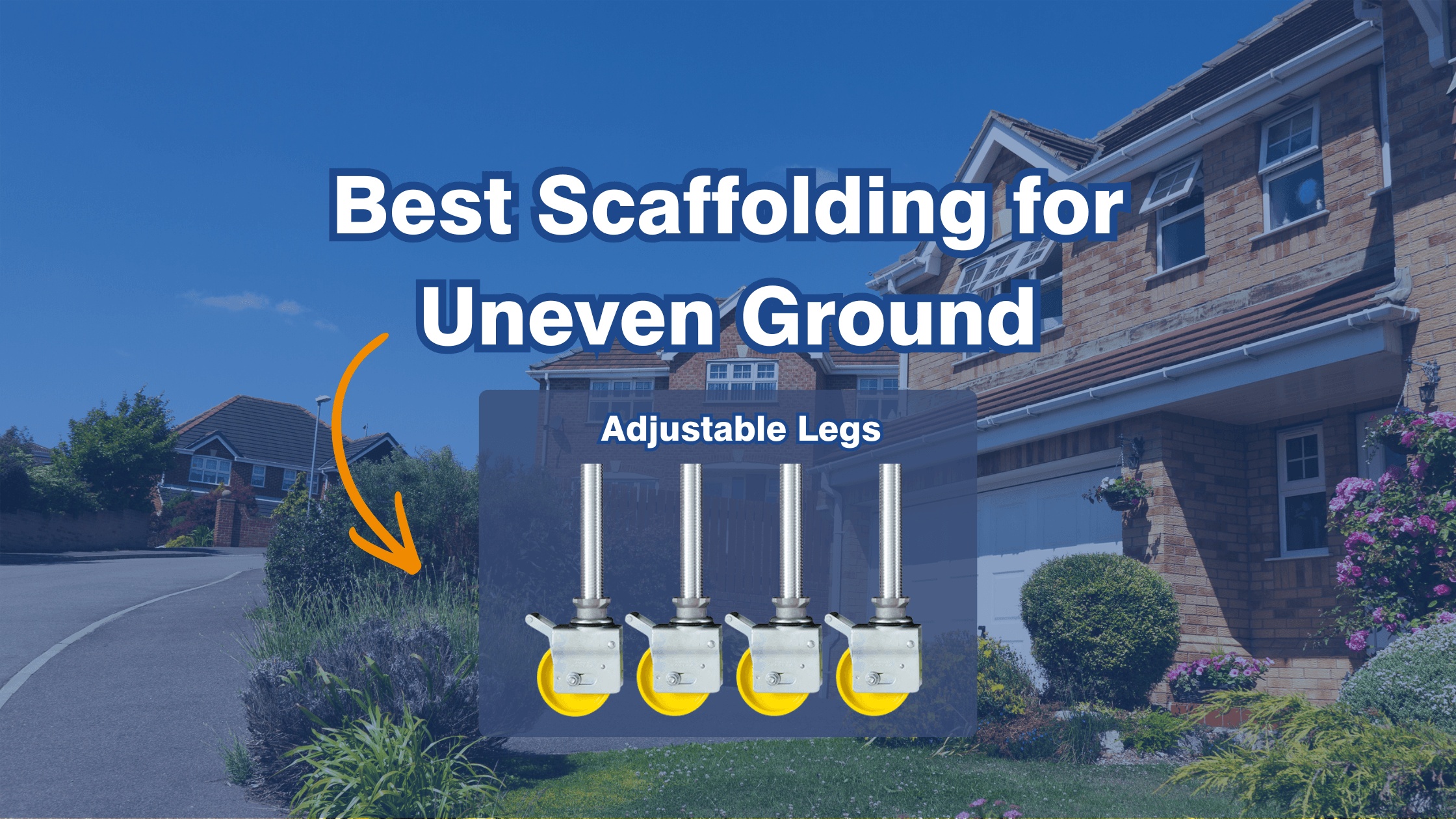
System scaffolding, sometimes called modular scaffolding, uses pre-engineered components that lock together at fixed nodes. The big advantage on uneven ground is the adjustable base plates that come standard with most systems. These screw jacks allow you to level each vertical standard independently, compensating for gradients of up to around 300mm in many cases.
The fixed connection points also mean the structure maintains its geometry even on a slope: there’s less room for error compared to tube and fitting. For larger projects on sloped terrain, system scaffolding is often the preferred choice because it’s faster to erect and the connections are inherently stronger.
The downside? Cost and availability. System scaffolding components are more expensive, and you need to match components within the same manufacturer’s system. It’s less forgiving if you need an unusual configuration.
Traditional Tube and Fitting Scaffolding
Tube and fitting remains the most versatile scaffold method for difficult ground. Because every joint is made with individual couplers, you can adapt the structure to virtually any terrain. Experienced scaffolders can create stepped bases, angled bracing, and custom configurations that no modular system can match.
On severely uneven ground, tube and fitting allows you to set each standard at a different height and brace accordingly. You’re not constrained by predetermined node spacings. This flexibility is why tube and fitting still dominates on complex residential and heritage projects where the ground is rarely cooperative.
The trade-off is skill. Tube and fitting scaffolding requires a competent scaffolder who understands load paths and bracing requirements. It takes longer to erect, and the quality of the finished structure depends entirely on the person building it. If you’re hiring scaffolders for a sloped site, make sure they hold the relevant CISRS card and have experience with non-standard ground conditions.
Aluminium Towers with Adjustable Legs
For smaller jobs and maintenance work, aluminium scaffold towers with adjustable legs are often the most practical solution for uneven surfaces. These towers are lightweight, quick to assemble, and designed specifically for single-trade access.
LEWIS scaffold towers are a strong option for tradespeople who regularly work on varied terrain. Their adjustable leg system lets you compensate for slopes and steps without compromising stability, and the aluminium construction means one person can transport and erect the tower without a crane or forklift. They’re also compatible with SGB Boss and Youngman Boss components, which is a real advantage if you’ve already got a mixed inventory from different suppliers.
The key limitation of any mobile tower on uneven ground is height. Most manufacturers specify a maximum allowable gradient for their towers, and exceeding this is dangerous. Always check the instruction manual for your specific tower model. If the slope exceeds the tower’s rated capability, you need a different solution.
Essential Components for Levelling and Support
Getting the right scaffold system is only half the battle. The components you use to interface between the scaffold and the ground make all the difference on uneven terrain.
Adjustable Screw Jacks and Base Plates
Screw jacks are the primary tool for levelling scaffolding on slopes. These threaded assemblies sit beneath each vertical standard, allowing you to raise or lower individual legs by turning the collar. Most screw jacks offer around 300mm of adjustment, though heavy-duty versions provide more.
The critical rule with screw jacks is never to extend them beyond the manufacturer’s maximum. Over-extending a screw jack creates a long, slender column that can buckle under load. As a general guide, the exposed thread should not exceed three times the diameter of the tube, though you should always follow the specific product data sheet.
Base plates sit beneath the screw jacks and spread the load onto the ground or sole board. Standard base plates are fine for firm, level surfaces, but on slopes you may need swivel base plates that can sit flush against angled ground without creating point loads on one edge.
Sole Boards and Timber Sleepers
Sole boards are non-negotiable on soft or variable ground. These timber boards (or sometimes steel plates) sit beneath the base plates and distribute the scaffold’s weight over a larger area, reducing the pressure on the ground surface.
The size of sole board you need depends on the ground’s bearing capacity and the load coming through each leg. On very soft ground, you might need to use multiple boards or full timber sleepers running beneath several standards. The boards should be:
- At least 225mm wide and 35mm thick for light-duty towers
- Centred beneath the base plate so the load is distributed evenly
- Placed on ground that has been cleared of debris and loose material
- Secured so they can’t slide on sloped surfaces
On a gradient, sole boards themselves can slide downhill. Pegging them into the ground or using a timber lip on the downhill edge prevents this. It’s a small detail that prevents a big problem.
U-Heads and Specialised Bracing
U-heads are fork-shaped fittings that sit atop standards, typically used to support beams in temporary works. On uneven ground, they’re useful for creating level bearing surfaces at the top of the scaffold, even when the base is stepped.
Specialised bracing becomes essential on slopes because the standard diagonal bracing patterns assume a level base. On a gradient, you need additional plan bracing and potentially face bracing to prevent racking. The bracing layout should be designed by someone competent to assess the forces involved: don’t guess.
Tie bars and anchors connecting the scaffold to the building also take on greater importance on slopes, because the structure’s tendency to lean or slide increases the lateral forces at tie points. More on this below.
Best Practices for Safe Installation
Having the right kit means nothing if the installation is poor. Here’s how experienced crews approach scaffold erection on uneven ground.
Conducting a Thorough Site Assessment
Walk the site before you unload a single component. Look at the ground surface, the gradient, and any obstacles. Dig a small test hole if you’re unsure about the soil type. Check for underground services: hitting a water main while pegging sole boards is not how you want to start your morning.
Measure the gradient using a spirit level and a straight edge. Record the height difference across the scaffold’s planned footprint. This tells you how much adjustment you’ll need at each leg and whether your chosen system can handle it.
Check the weather forecast too. Ground that’s firm in July can become treacherous in November. If you’re working on clay soil, factor in seasonal movement: clay swells when wet and shrinks when dry, which can alter your levels over time. For longer-duration projects, plan for periodic re-levelling.
Securing the Structure to the Building
Ties are your insurance policy. On flat ground, a well-braced scaffold tower can be reasonably stable without ties at lower heights. On a slope, ties become critical much earlier because the structure’s centre of gravity is already compromised.
Follow the tie pattern specified in your design or the manufacturer’s guidance. For LEWIS aluminium towers and similar products, the instruction manual will specify when ties are required based on height and configuration. Don’t treat these as suggestions. They’re safety requirements.
Use through-ties or box-ties where possible, as these provide the strongest connection. Anchor ties into solid masonry, not into mortar joints or lightweight blockwork. Each tie should resist both tension and compression, because wind loads can push or pull the scaffold away from or into the building.
Using Spirit Levels and Plumb Lines
This sounds basic, and it is. But you’d be amazed how many scaffold structures on slopes are erected without anyone checking plumb and level during the build. On flat ground, small errors tend to average out. On a slope, they accumulate.
Check plumb at every lift. Use a spirit level on each standard and a plumb line from the top of the structure to confirm the overall verticality. Check level across every platform, not just at the base. If a platform is out of level, the workers on it are standing on a slope, which increases the risk of trips and falls.
Build the habit of checking after every stage, not just at the end. Correcting a problem at the second lift is quick. Correcting it at the sixth lift means dismantling half the structure.
Legal Requirements and Safety Standards in the UK
Working at height in the UK is governed by specific legislation, and scaffolding on uneven ground doesn’t get any exemptions. If anything, the legal requirements become more demanding because the risks are higher.
Work at Height Regulations 2005
The Work at Height Regulations 2005 remain the primary legislation governing scaffold use in 2026. They require that all work at height is properly planned, supervised, and carried out by competent persons. The regulations mandate that equipment used for work at height, including scaffolding, is suitable for the task, properly maintained, and inspected at prescribed intervals.
On uneven ground, “suitable for the task” is the key phrase. Using a standard tower on a gradient that exceeds its design parameters isn’t just risky: it’s a breach of the regulations. The duty holder (usually the employer or the person controlling the work) must ensure the scaffold is appropriate for the specific ground conditions.
Scaffold inspections must occur before first use, after any event likely to affect stability (including heavy rain on soft ground), and at intervals not exceeding seven days. Each inspection must be recorded.
HSE Guidelines for Temporary Structures
The Health and Safety Executive publishes detailed guidance on scaffold erection, including specific advice for non-standard ground conditions. SG4:15, the industry code of practice for scaffolders, covers safe methods of erecting and dismantling scaffolding and includes provisions for working on slopes.
The HSE expects that scaffolding on uneven ground will have a specific design or method statement prepared by a competent person. For complex configurations, this may mean involving a structural engineer or a scaffold design consultant. The guidance is clear: if the standard configuration doesn’t fit the site, you need a bespoke solution designed by someone qualified.
Non-compliance carries serious consequences. HSE inspectors can issue improvement notices, prohibition notices, or prosecute. Fines for work at height offences regularly reach six figures, and in cases involving serious injury or death, custodial sentences are possible.
Maintaining Scaffolding Integrity on Shifting Ground
Erecting a scaffold on uneven ground is not a one-and-done job. Ground conditions change, especially on longer projects. Rain softens soil. Frost heaves foundations. Construction activity nearby can alter drainage patterns or vibrate the ground.
Build regular inspections into your programme. Check the levels weekly at minimum, and after any significant weather event. Look for signs of settlement: gaps appearing between base plates and sole boards, standards that have gone out of plumb, or bracing that’s become slack. Any of these indicate the ground has moved and the scaffold needs attention.
Keep the area around the scaffold base clear. Stockpiling materials against the base or allowing water to pool around the foundations accelerates ground deterioration. Simple drainage measures, like a shallow trench directing water away from the base, can make a real difference on clay or silt soils.
If you’re using LEWIS scaffold towers or similar aluminium systems, the lightweight construction is actually an advantage here: less weight means less load on the ground and slower settlement rates. But lighter structures are also more susceptible to wind, so maintain your ties and check them regularly.
So, what’s the best scaffolding for uneven ground?
The best scaffolding for uneven ground is ultimately the system that’s properly specified, correctly erected, and diligently maintained throughout its use. No single product solves every problem. The right answer depends on your specific site, your specific task, and your willingness to do the job properly from the ground up. Take the time to assess, plan, and inspect. Your safety, and the safety of everyone working on and around the structure, depends on it. If you’re looking for aluminium towers with genuine adjustability and proven reliability on difficult terrain, LEWIS Access delivers UK-wide from their London manufacturing base, with over 3,000 five-star reviews from tradespeople who’ve put their products to the test on real sites.